
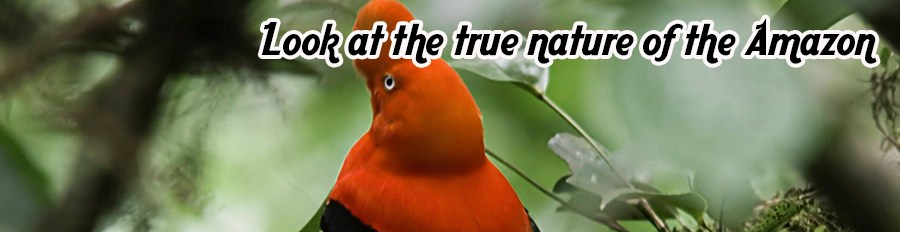
The Cock Of The Rock or tunqui (Rupícola peruviana), notable for the incredible beauty of its plumage, is a species of passerine bird of the Cotingidae family that lives in the Amazon region of Peru.

According to Supreme Resolution 983 of the Ministry of Foreign Affairs, promulgated in the government of President Manuel Prado on December 11, 1941, the Peruvian ruler is the national bird of Peru. Due to its incomparable plumage and many individual and collective manifestations, it is admired in the world as one of the most beautiful and delicate birds.
Characteristics and Habitat
It is medium in size, about 35 centimeters. The male is a beautiful intense orange-red color, orange eyes, yellow legs and beak, with black wings and tails. The female is dark reddish brown.
In Peru it is located in protected areas such as the national parks of Río Abiseo, in San Martín; Yanachaga-Chemillén, in Pasco; Tingo María, in Huánuco; and Manu, in Cusco-Madre de Dios. Also in protection forests such as Alto Mayo, in San Martín; San Matías-San Carlos, in Pasco; and Pui-Pui, in Junín. Also, in the forests of San Ignacio, in the Cutervo National Park, in the historic sanctuary of Machu Picchu and other similar territories, along the eastern slope of the Andes.
They live in groups of 10 to 20 individuals. The roosters of the rocks lay their eggs in the crevices of the cliffs. It is very rare to find a lonely cock, since they always live in small communities. They remain hidden most of the day and only leave the forest at certain times. It has been seen on the banks of rivers bathing and drinking water.
Feeding
The Peruvian rock rooster feeds on a large number of wild fruits, which grow in large quantities in the mountain forest of the eastern Andean slopes.
The roosters of the rocks are frugivorous (they feed on fruits). This is a consequence of the fact that between 50% and 80% of the trees in the Amazon rainforest produce fruits as a propagation mechanism. In addition to its proven abundance, additional factors such as the availability and diversity of wild fruits will determine that it is possible to find fruits at any season or time of the year, although the quality of the food is not the same throughout the year.
Reproduction
The sexual courtship of the rupícolas has a special meaning. Males gather at sites called ‘singers’ to run a kind of dance and singing contest. Placed in absolute orders, they are offered to females performing their best performance, in which the crest plays a leading role because it is the one that attracts them the most.
Important data
These birds are large disseminators of seeds in the Jungle, which contributes to the preservation of forests. In this way they help the natural regeneration of their environment. Currently it is estimated that there are about 3,000 copies, so their protection at the national level is urgent.


 vertigotravelperu.travel.blog