

The PNM is home to a large number of wildlife species. There have been about 160 species of mammals, more than 1,000 species of birds (mostly residents), about 140 species of amphibians, 50 species of snakes, 40 lizards, 6 turtles, 3 alligators and 210 fish .
MANU TOURS INFORMATION

Among the large mammals, the otorongo (Panthera onca), the black tiger (Felis yagouaroundi), the sachavaca (Tapirus terrestris), the huangana (Tayassu pecari), the sajino (Tayassu tajacu), the deer (Mazama americana), the deer stand out ash (Odocoileus virginianus), the river wolf (Pteronura brasiliensis), the ronsoco (Hydrochoerus hydrochaeris), the monkey preserve (Alouatta seniculus), the black maquisapa (Ateles paniscus), the monkey monkey (Lagothrix lagotricha), the white machín monkey ( Cebus albifrons) and the black machin monkey (Cebus apella).

On the other hand, the number of insects in the PNM is very high. It is estimated that there are about 30 million species. In turn, more than 1,300 species of butterflies, 136 of dragonflies, at least 300 of ants (more than 40 species were found in a single tree) and more than 650 beetles.
With regard to the flora of the PNM, the number of plant species is very high. The various records indicate that there are at least 162 families, 1,191 genera and 4,385 identified species. Up to 250 varieties of trees were found in a single hectare. Aguajales forests are one of the most prominent ecosystems, where aguaje (Mauritia flexuosa) and huasaí (Euterpe precatoria) palm trees are dominant. They develop over almost permanently flooded areas, especially on the right bank of the Manu River.
It also highlights the presence of cedar (Cedrela sp.), Acetic (Cecropia sp.), Screw (Cedrelinga catenaeformis), chestnut (Bertholletia excelsa), lupuna (Chorisia sp.) And jebe (Hevea brasiliensis) .
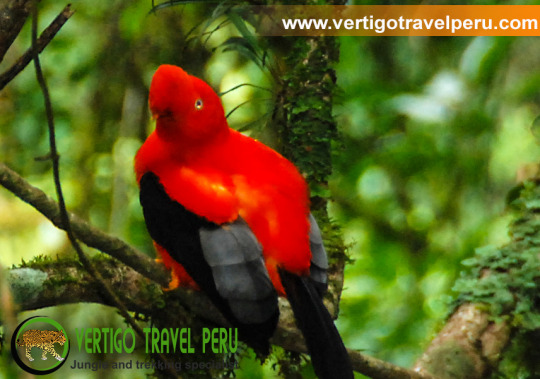
A total of 500 birds only around lowland forests at the Cocha Cashu Biological Station, and the checklists of Terborgh, Janson and Brecht (1984) give habitats, feeding position, activity (sociability) and abundance of all birds and mammals found until 1982. Bird species found in Manu account for 25% of all known birds in South America and 10% of all species in the world and it is thought that they can more of 1,000 bird species in total. According to Renton (1990), six species of macaws occur in lowland forests, Ara ararauna, A. chloroptera, A. macao, A. severa and A. manilata.
Three Areas of Endemic Birds are represented in the park, the lowlands of the Peruvian southeast (B30), home to 15 species of restricted range, the eastern Andes of Peru (B29), with 11 species of restricted range, and the western Andes of Peru (B27) with 30 species of restricted distribution (ICBP, 1992).
There are 13 species of monkeys, and it is estimated that there are more than 100 species of bats. There are also 12 species of reptiles within 7 families (ANU-CEPID, 1986), and 77 species of amphibians of the fire families are known by the Cocha Cashu area (Rodriguez, in press). There are no checklists for invertebrates, although it has been estimated that the park contains about 500,000 species of arthropods. Again, most of the information has been collected in the lowlands, and little detailed information is available on mountain wildlife. Species known as globally threatened that occur in the park include the monkey monkey Lagothrix lagotricha, Emperor Tamarin Saguinus imperator, giant otter Pteronura brasiliensis (VU), giant anteater Myrmecophaga tridactyla (VU), giant armadillo Priodontes maximus (EN) , the ocelot Felis pardalis, Oreailurus jacobita Andean cat (VU), the jaguar Panthera onca, small ear fox Atelocynus microtis (DD), Speothos venaticus mount dog (VU), the northern Andes Huemul Hippocamelus antisensis (DD), Tremarctos ornatus spectacled bear (VU), crocodilus crocodilus crocodile, and black caiman Melanosuchus niger (ES).

Fish species identified by Groenendijk and Hajek (1995) that are consumed by local inhabitants include Macroponum Colossoma gamitana, paco Piaratus brachypomus, shad red tail erythropterum Brycon, Prochilodus nigricans, boquichico, lisa and trifasciatus Leporinus fasciata Schizod lisch.
On a hectare of plot in the floodplains, 17 trees with a diameter of more than 70 cm were found (4 to 11 trees with such a diameter would be more normal). The largest tree was a Ceiba pentandra (120 cm), while others include the local level armata Poulsenia rare (110 cm) and Calycophyllum sp. (117 cm), and locally endangered Swietenia macrophylla (105 cm) and Dipteryx odorata (100 cm). The most common tree on the plot was Otoba parviflora (IK), and other very abundant species including the palms of the genera Astrocaryum, Iriartea and Scheelea, two species of Quararibea (Bombacaceae), Guarea and Trichilia (Meliaceae, both from the undergrowth) , one (Pouteria (Sapotaceae), Pseudolmedia laevis (Moraceae) and Theobroma cacao Sterculiaceae). Another notable feature of these forests is the great abundance of Ficus sp., Of which there are at least 18 species – only 15 species of Ficus are mentioned in the Flora of Peru (Standley, 1937). Lianas are common, and 79 lianas of 43 species were found within 1,000 square meters. With current knowledge of the park’s flora, it is not possible to give a detailed account of those found in threats, endemic or species that may be economically important Swietenia macrophylla and Cedrela odorata, which grow in almost pure stands, are two of the economically important species for their wood, while Theobroma cacao and Quararibea cordata (CI) are grown for their fruit outside the park. MANU

 vertigotravelperu.travel.blog