
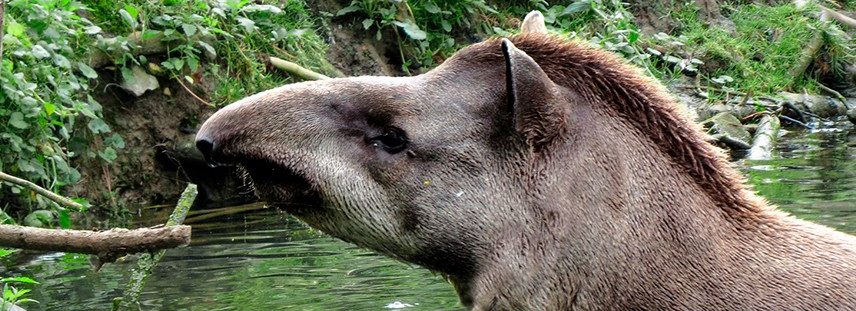
The Ministry of Agriculture and Irrigation (Minagri), through the National Forest and Wildlife Service (Serfor), published the National Andean Tapir Conservation Plan, in order to preserve this species that is in critical danger of extinction.

There are only five tapir species on the planet and in Peru two of them inhabit, the Andean tapir (Tapirus pinchaque) and the Amazon or sachavaca (Tapirus terrestris), both species of sociocultural, biological and economic relevance from pre-Columbian Peru. MANU TOURS INFORMATION.
The Andean tapir, also called mountain tapir, danta or pinchaque, is the smallest and perhaps the least studied of the two species present in Peru. It is distributed in the montane and moor forests of Colombia, Ecuador and northern Peru, between 2,000 and 4,000 meters above sea level, in the montane forests and moors of the Piura and Cajamarca regions.
A population of 2,500 individuals has been estimated within a range of 3,000 square kilometers of habitat available for this species between Colombia and northern Peru.
As one of the largest mammals distributed in the tropical Andes, its relevance lies in its important role as a seed disperser, given that studies have shown that it feeds on up to 264 species and is potentially a disperser of at least 50 species of flora, also providing a suitable substrate to the soils where it lives and generating paths for other wildlife species. In this sense, this species is considered as a key to maintaining the structure of high mountain ecosystems in northern Peru.
Because of its important role in the ecosystem and given that its home environment is broad, the tapir is considered an “umbrella species”, since its conservation can benefit many other species in its range of distribution.
The Andean tapir is very sensitive to anthropic disturbances (caused by humans), so that continuous impacts on an area occupied by the species can cause it to be abandoned. Among the main threats identified for the species is the fragmentation and deterioration of their habitat, the development of illegal or unplanned extractive activities and subsistence hunting to a lesser extent.
For these reasons, the species is categorized as “Critically Endangered” (CR) according to Supreme Decree No. 004-2014-MINAGRI by which the classification and categorization of threatened wildlife species legally protected is updated, being therefore considered as a threatened species.
It is also classified as threatened «Endangered» by the International Union for the Conservation of Nature (IUCN) and is included in Appendix I of the Convention on International Trade in Endangered Species of Wild Fauna and Flora (CITES).
The approval of a National Conservation Plan for this species would add Peru within the countries that identify and prioritize lines of action in favor of the conservation of this mammal, promoting conservation actions from a technical, political, scientific and management perspective to Nacional level.
The conservation of this species is of particular interest in being associated with the moors, which are considered as fragile ecosystems according to national legislation, containing an important diversity of unique flora and fauna, in addition to being providers of ecosystem services for human populations.
MORE INFORMATION OF PERU

 vertigotravelperu.travel.blog