
MANU INFORMATION:

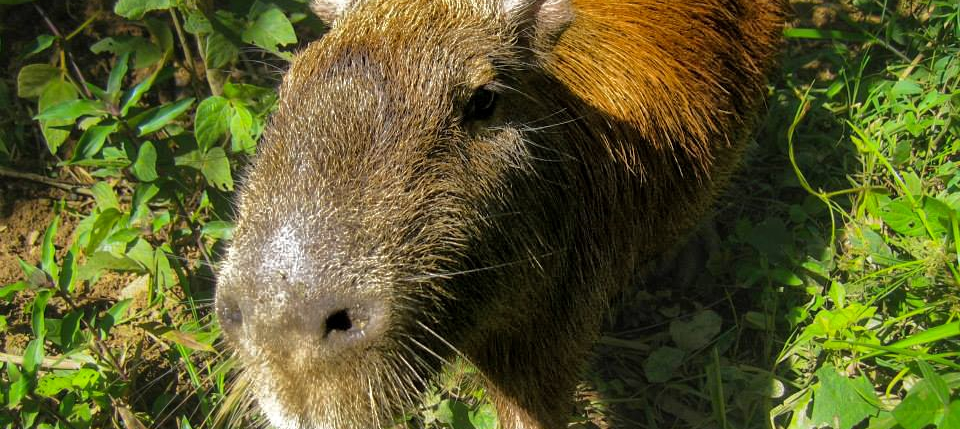
The Ronsoco is the largest rodent, weighing from 35 to 66 kg and with a length of approximately 1.2 m. Females of this species are slightly larger than males. Its coat is thick and thin, and is reddish brown on most of the body, turning yellowish brown on the belly and sometimes black on the face. The body is barrel-shaped, sturdy and tailless. The front legs are slightly shorter than the hind legs, and the feet are partially webbed. This, in addition to the location of the eyes, ears and nostrils on the top of the head. Males have a bare lump on top of the snout, known as the andir gland, which secretes a white liquid. The smell of this liquid acts as an olfactory «footprint» for signaling the state of the individual. Both males and females have two glands on both sides of the anus (Frens, K. 2009). It has a long, tall and wide head, the muzzle is obtuse, with cleft upper lips, the ears are small, hairless and very, mobile, at rest it stands on its hind legs. The forelegs have four toes and the hind legs three. All fingers are linked together by small swimming membranes and are provided with strong, thick nails. Lacking a tail instead, it has a fold that hides the anus and genitalia. The andir is visible from the first year of age in males and continues to develop in adult males until it reaches a size of between 8 and 10 cm. It consists of numerous secreting cells of a sticky white liquid that serves to mark the territory of the family group. Females have six pairs of functional teats, distributed from the pectoral to the inguinal area, and nurse their offspring. It is the only one that has sweat glands on its skin, its epidermis is wavy with numerous cavities and folds, the dermis contains numerous hair follicles, generally in groups of three, each of which has an associated developed sweat gland. Each hair emerges at a very acute angle and each hair follicle has an associated piloerector muscle and respective sebaceous gland. It is characterized by having four highly developed incisors and the absence of canines, the continuously growing incisors, are strong, long and sharp, and each pair is closely linked. MANU TOURS INFORMATION

 vertigotravelperu.travel.blog