
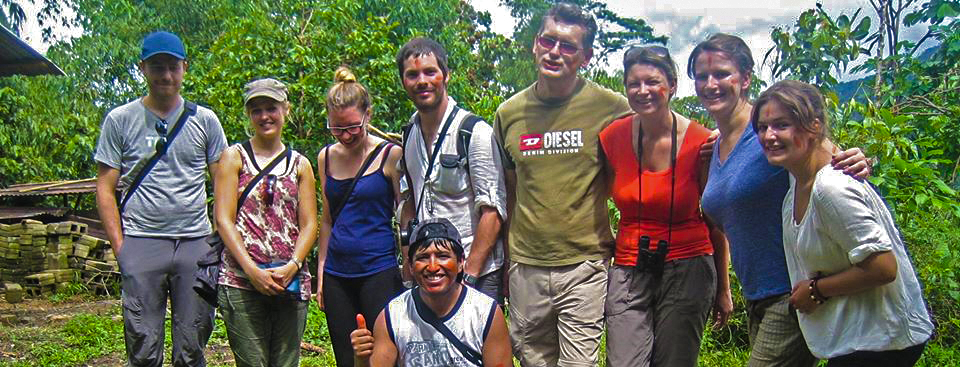
Located in the jungle of the departments of Cusco and Madre de Dios, the Manu National Park represents the greatest natural treasure in Peru, due to the number of species it houses and the diversity of ecosystems it protects. Manu is one of the few wild areas in the world where animals abound and live in a totally natural state. The Manu jungle offers an extraordinarily high density of wildlife, mammal clay licks and macaws where the animals are concentrated and easy to spot. Exotic birds such as the Gallito- Hormiguero Frentirrufo, Cotinga Carinegra. No other area in America offers such excellent sighting of rare or difficult-to-observe animals. MANU TOURS INFORMATION.

Location
Cusco and Madre de Dios. 1400 kilometers from Lima. It was established as a national park in 1973 on an area of 1,532,806 hectares and declared a Natural World Heritage Site by UNESCO in 1987.
Altitude
It covers a latitudinal variety that ranges from 4,300 meters above sea level in the high Andean highlands to 200 meters above sea level in the Amazon plain. On average, the areas included in the visits are 183 m.a.s.l.
Access
An affirmed highway starts from Cusco and leads to the towns of Atalaya and Shintuya (at 9 and 12 hours respectively), points from where it is possible to start the journey by river (5 to 6 hours). There are also light aircraft flights linking Cusco and the town of Boca Manu (30 minutes), from which it is necessary to continue by river (4 to 6 hours). You have to hire the services of the agencies authorized for it.
It is from the city of Lima, by air, or from the city of Puerto Maldonado, the Reserve can be reached by land or river.
Weather
Rainy season from December to March, although showers are not uncommon outside of it. The months of May to August, with temperatures above 30 ° c, are the most recommended for your visit. The normal climate of this area ranges from 26 ° c to 32 ° c, but on rainy days it is from 13 to 18 ° c.
Flora and fauna
The reserve is inhabited by various ethnic groups known as the Amahuaca, Huachipaire, Machiguenga, Piro, Yora, and Yaminahua, as well as others without any contact with the modern world.
Manu National Park is the natural environment for more than 20,000 vascular plants, 1,200 species of butterflies, 1,000 of birds, 200 of mammals, and still unknown numbers of reptiles, amphibians, and insects.
For being one of the largest parks in South America. The park area comprises part of the mountainous area of the department of Cusco and the jungle of the department of Madre de Dios. The Manu covers two million hectares in a territory rich in flora and fauna species in a wide variety of high Andean habitats, cloud forest and rain forest. UNESCO officially recognizes the natural paradise of Manu as a World Heritage Site, and later in 1997 named it World Biosphere Reserve, as it houses the greatest Biological Diversity in protected areas of rain forest and various endemic species of cloud forest.
Fortunately, Manu is almost intact, probably because it has stayed away from civilization.
In addition, we can observe a variety of animals in their different habitats, including: Giant Otters, the Black Caiman, the Jaguar, the Spectacled Bear, the Tapir, the Tigrillo, as well as 13 species of monkeys and approximately one thousand species of birds including seven kinds of Macaws
Manu also protects 10% of the plant species in the world, including various species of figs and palms, in addition to the countless species of medicinal plants that are currently being classified by scientists. A single hectare of rainforest in Manu can host more than 220 tree species, while a hectare of temperate forest in Europe and North America could have only 20 tree species. Manu National Park is probably the most biologically diverse protected park in the world.
In its almost one and a half million hectares, the park maintains an incomparable biodiversity in the world and its territory ranges from the heights of the puna, the humid and tropical forest and the Amazon plain.

 vertigotravelperu.travel.blog