
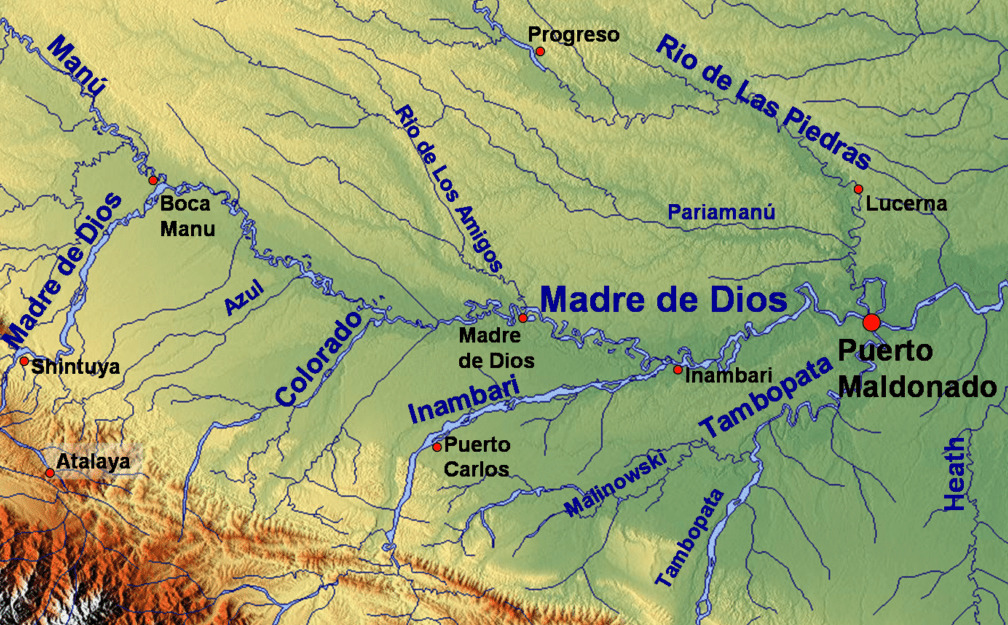
The Manu River is located in southern Peru, in the Manu National Park, which was declared by UNESCO as a World Heritage Site of the Biosphere Reserve in 1977.

Source and length of the Manu river
The Manu River is born from calm and crystalline waters, coming from the eastern slopes of the Andes, in the Amazon river basin.
It has a length of 356 km that advance in everything in the territory of the Madre de Dios region, 1,400 meters above sea level.
Its climate is warm and humid, with annual precipitations superior to 1000 mm, between January and March, although it can rain unexpectedly the rest of the year. It has average annual temperatures between 20 ° C during the night and maximums of 35 °, during the day, and there are also shady areas with misty tree ferns that create a cold climate.
Tributaries and mouth of the Manu river
The Providencia River and the Piriquina River feed the waters of the Manu River since the Matsiguenka indigenous people populated its banks
The Manu River flows into the area known as Alto Madre de Dios, the homonymous river, very close to the town of Boca Manu and the departments of Cuzco, Paucartambo Province, Kosñipata District and Madre de Dios, Manu Province, Districts Fitzcarrald and Manu, covering the entire Manu River basin.
Manu National Park
The Manu River is the place of the highest biological concentrations on the planet, with 19,098 km2, which is why Unesco named it a World Heritage Site of the Biosphere Reserve for more than 40 years.
This mighty river runs through the Manu National Park, which can only be visited under special permission, since it is only intended for the protection of it and its inhabitants and only anthropological and biological study and research activities can be carried out, concerning observation of the life and processes of the ecology of the place and its natural form.
Amazonian Indians from various tribes such as the Matsiguenka, Mashco Piro, Amahuaca, Yine, Amarakaeri, Huashipaire and Nahua live in the park. In the almost 30 native and peasant communities, they maintain the Quechua mother tongue.
The Manu river is surrounded by numerous species of vascular plants, such as figs and palms, and medicinal plants that serve as studies for scientists. It is claimed that just one hectare of forest can have up to 220 tree species.
Within the highly particulate fauna found in the Manu River, more than 222 types of mammals, 155 amphibians, 132 reptiles and more than 1005 species of birds are counted, among which there are several endangered species.
Among the most protected are: the Cock of the Rocks, Red Macaw, Roseate Spoonbill, Coca Heron, Carrasco, Casique Lomi Amarillo, Black Spider Monkey, Capuchino de Frente Blanca, Caimán Negro, Jaguar Onca, otters, bats, ants and birds .
Tourism in the Manu River
Access to the area surrounding the Manu river is very restricted, but eventually the entrance to previously authorized tourist groups is authorized, with very specific recommendations for their protection, such as first aid and prevention against altitude, since it is common for dizziness to occur, headaches and nausea.
Good hydration is recommended, carry basic and adequate medications to the risks of the area and it is essential to be vaccinated against yellow fever, 72 hours in advance. MANU TOURS INFORMATION

 vertigotravelperu.travel.blog